Challenges and Opportunities of Advanced Data Analytics in Retail Sector
- Sandhiya Koteshwaran

Is Your Retail Business Truly Maximizing Its Data Potential?
In today’s competitive landscape, advanced retail analytics transforms how businesses understand consumer behavior, manage inventory, and personalize customer experiences.
But while data-driven insights offer immense opportunities, retailers also grapple with challenges like data silos, privacy concerns, and the need for specialized expertise.
At Hashmato, we help businesses navigate these complexities by leveraging cutting-edge analytics solutions.
In this blog, we’ll explore the key challenges and opportunities that advanced data analytics presents in the retail sector—helping you stay ahead in an ever-evolving market.
What is Advanced Data Analytics in Retail?
Advanced analytics in retail leverage technologies like artificial intelligence (AI), machine learning (ML), and big data to help businesses make data-driven decisions.
Unlike traditional analytics, which focuses on past performance, advanced analytics predicts future trends, optimizes operations, and enhances customer experiences.
Key applications of advanced analytics in retail include:
- Demand forecasting – Predicting product demand to optimize inventory.
- Dynamic pricing – Adjusting prices based on demand, competition, and market conditions.
- Fraud detection – Identifying and preventing fraudulent transactions.
- Customer insights – Analyzing shopping behavior for personalized marketing.
By adopting advanced analytics, retailers can improve efficiency, reduce costs, and create a more seamless and personalized shopping experience.
With a clear understanding of what advanced analytics in retail entails, let’s now take a look at the challenges many businesses face when implementing these powerful tools.
Challenges in Implementing Advanced Data Analytics
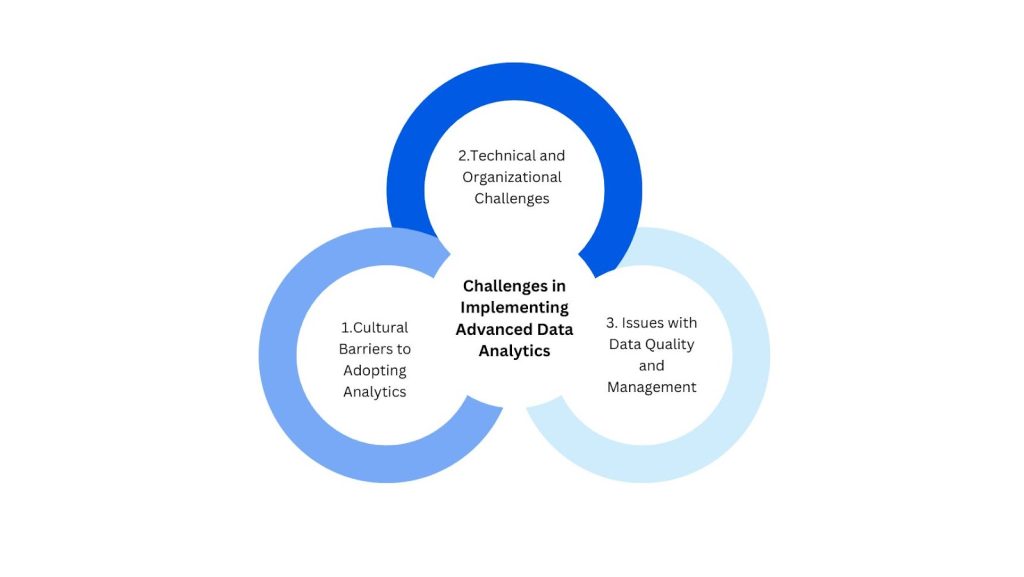
While advanced analytics in retail has the potential to transform operations, several challenges can hinder its successful implementation. These challenges range from cultural resistance to technical limitations and data management issues.
1. Cultural Barriers to Adopting Analytics
Many retailers still rely on traditional decision-making processes based on experience and intuition rather than data. Employees and management may resist data-driven strategies due to fear of change, lack of understanding, or skepticism about the accuracy of analytics.
Encouraging a data-driven culture requires strong leadership support, employee training, and clear communication on the benefits of analytics.
2. Technical and Organizational Challenges
Implementing advanced analytics requires specialized skills and modern infrastructure. However, many retailers face:
- Lack of skilled personnel – Data scientists, analysts, and IT professionals are needed to interpret and apply analytics effectively, but such expertise is a shortage.
- Outdated systems – Many retailers still use legacy systems that cannot handle large-scale data processing, making it challenging to integrate new analytics tools.
- Scalability issues – As businesses grow, their analytics infrastructure must scale accordingly, which can be costly and complex.
To overcome these challenges, businesses must invest in upskilling employees, upgrading IT infrastructure, and adopting scalable cloud-based analytics solutions.
3. Issues with Data Quality and Management
Data must be accurate, consistent, and well-structured for analytics to provide valuable insights. Common issues include:
- Incomplete or inconsistent data – Poor data entry practices, different data formats, or missing values can lead to unreliable insights.
- Data silos – When different departments store data separately, it becomes challenging to consolidate and analyze it effectively.
- Privacy and security concerns – Handling customer data requires compliance with regulations like GDPR or CCPA, adding complexity to data management.
To address these issues, retailers need robust data governance strategies, regular data quality checks, and secure storage solutions to ensure data integrity and compliance.
By tackling these challenges, businesses can unlock the full potential of advanced analytics in retail, leading to better decision-making, improved efficiency, and enhanced customer experiences.
Now that we’ve discussed the challenges, let’s take a look at the exciting opportunities advanced data analytics brings to the table for retailers.
Opportunities and Benefits of Advanced Data Analytics
As retailers navigate the challenges of digital transformation, advanced retail analytics presents significant opportunities to enhance operations, drive profitability, and improve customer satisfaction. Here are some key benefits:
1. Enhancing Customer Engagement Through Personalized Experiences
Advanced analytics enables retailers to understand customer behavior by analyzing shopping patterns, preferences, and past interactions. This allows businesses to:
- Deliver personalized product recommendations based on browsing and purchase history.
- Customize marketing campaigns with targeted promotions and offers.
- Optimize customer service by predicting needs and improving engagement.
By leveraging real-time data, retailers can create a more personalized shopping experience, increasing customer loyalty and satisfaction.
2. Optimizing Pricing Strategies for Better Profitability
Data-driven pricing strategies help retailers stay competitive while maximizing revenue. With advanced analytics, businesses can:
- Implement dynamic pricing by adjusting prices based on demand, competitor pricing, and market trends.
- Identify optimal discount strategies to boost sales without hurting profit margins.
- Use predictive analytics to forecast demand fluctuations and set prices accordingly.
These insights enable retailers to improve profitability while ensuring competitive pricing in the market.
3. Improving Supply Chain and Inventory Management
Retailers rely on efficient supply chains to meet customer demand and reduce operational costs. Advanced analytics provides:
- Demand forecasting – Predicting sales trends to prevent stockouts or overstocking.
- Inventory optimization – Ensuring the right products are available at the right time.
- Supplier performance analysis – Evaluating vendors to improve delivery efficiency and cost-effectiveness.
By leveraging data, retailers can enhance supply chain agility, reduce waste, and improve overall efficiency.
4. Detecting and Preventing Fraudulent Activities
Fraud detection is critical for retailers, especially in e-commerce and digital transactions. Advanced analytics helps by:
- Identifying unusual transaction patterns that indicate fraudulent activity.
- Enhancing cybersecurity measures with AI-driven fraud detection systems.
- Reducing chargeback losses by detecting fraudulent orders in real-time.
Retailers can minimize financial losses and protect customer trust with real-time fraud monitoring.
Understanding the different types of analytics is key to making the most of your data. Let’s break down the types and see how each can benefit your retail business.
Harnessing Different Types of Data Analytics
To fully leverage advanced analytics in retail, businesses must understand and utilize different types of data analytics. Each type serves a unique purpose, helping retailers make informed decisions, optimize operations, and enhance customer experiences.
1. The Four Types of Data Analytics in Retail
- Descriptive Analytics – Focuses on past data to provide insights into trends and performance. Retailers use it to analyze historical sales, customer behavior, and inventory turnover.
- Diagnostic Analytics – Helps retailers understand why certain trends or events occur. For example, if sales drop, diagnostic analytics can identify the reasons, such as pricing changes or shifting customer preferences.
- Predictive Analytics – Uses data modelling and machine learning to forecast future trends. This is particularly useful for demand forecasting, customer behavior predictions, and risk assessments.
- Prescriptive Analytics – Provides actionable recommendations by analyzing data and suggesting the best course of action. Retailers can use it to optimize pricing, recommend personalized promotions, or improve inventory management.
2. Benefits of Leveraging Data Analytics in Retail
By integrating these analytics types, retailers gain multiple advantages, such as:
- Enhanced Decision-Making – Retailers can make data-driven choices rather than relying on guesswork, improving efficiency and profitability.
- Improved Demand Forecasting – Predictive analytics helps retailers anticipate demand changes, optimize inventory levels, and avoid stock shortages or overstocking.
- Personalized Customer Experiences – Retailers can analyze customer data to deliver tailored product recommendations and targeted marketing campaigns.
- Optimized Pricing Strategies – Dynamic pricing models based on real-time data ensure competitive pricing while maximizing revenue.
Having the right tools is crucial for success. In the next section, we’ll explore some of the best technological solutions that help retailers make the most out of their data.
Technological Tools for Data Analytics
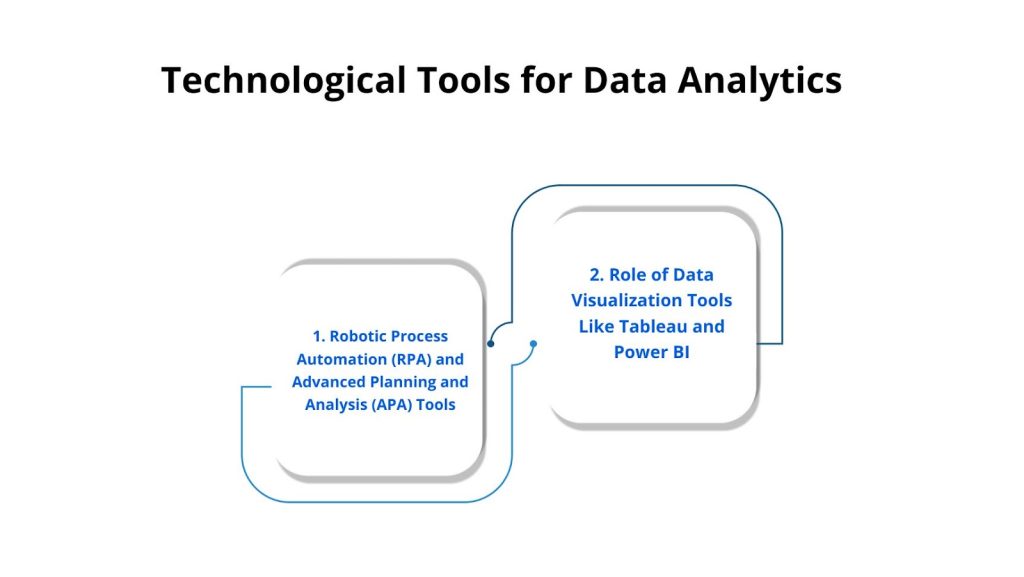
To unlock the full potential of advanced analytics in retail, businesses must leverage cutting-edge technological tools. These tools help automate data collection, enhance forecasting accuracy, and visualize insights for better decision-making.
1. Robotic Process Automation (RPA) and Advanced Planning and Analysis (APA) Tools
- Robotic Process Automation (RPA) – RPA streamlines repetitive tasks such as data entry, inventory updates, and sales reporting. By automating these processes, retailers can reduce manual errors, improve efficiency, and free up resources for strategic tasks.
- Advanced Planning and Analysis (APA) Tools enable retailers to analyze real-time data, optimize supply chain management, and improve demand forecasting. APA tools help businesses anticipate market changes, adjust pricing strategies, and enhance overall operational planning.
2. Role of Data Visualization Tools Like Tableau and Power BI
- Tableau – A powerful analytics platform that transforms complex data sets into interactive dashboards. It allows retailers to visualize customer behavior, sales trends, and inventory performance, making it easier to spot patterns and insights.
- Power BI – A Microsoft tool that integrates with various data sources, providing real-time business intelligence. It helps retailers track key performance indicators (KPIs), identify inefficiencies, and improve decision-making through intuitive visualizations.
The retail industry is constantly evolving. Let’s look at future data analytics trends that will help retailers stay ahead of the curve.
Promising Future Trends in Retail Analytics
With rapid technological advancements, retailers are increasingly adopting new trends to stay competitive and meet changing consumer expectations. Here are some key trends that are shaping the future of retail analytics:
1. Hyper-Personalization in Marketing and Customer Experiences
As customer expectations continue to evolve, retailers are moving towards hyper-personalization, where each shopper is treated as an individual. Advanced analytics allows retailers to:
- Analyze customer data in real-time, delivering tailored experiences and product recommendations.
- Create personalized marketing campaigns based on customer preferences, behaviors, and past purchases.
- Optimize loyalty programs with data insights to reward customers with offers that resonate with them.
This level of personalization enhances customer satisfaction, drives customer loyalty, and increases sales.
2. Integration of Augmented and Virtual Reality with Analytics
Integrating augmented reality (AR) and virtual reality (VR) with analytics transforms how customers engage with products and brands. Retailers are using these technologies to:
- Provide virtual try-ons for products like clothing, eyewear, or cosmetics, enabling customers to visualize how they’ll look without visiting a store.
- Enhance in-store experiences with AR-powered interactive displays that provide additional product information in real-time.
- Use VR for immersive shopping experiences, helping customers visualize products in various settings or environments.
By combining these immersive technologies with data insights, retailers can create highly engaging and innovative shopping experiences, leading to higher conversion rates.
3. The Growing Role of AI and Machine Learning in Retail Operations
Artificial intelligence (AI) and machine learning (ML) are rapidly transforming retail operations by automating processes, enhancing customer experiences, and improving decision-making. Key uses of AI and ML include:
- Demand forecasting and inventory management, helping retailers predict customer demand and optimize stock levels.
- Customer service automation through AI-driven chatbots that provide instant responses to customer inquiries.
- Price optimization and dynamic pricing allow retailers to adjust prices in real time based on customer demand, competitor pricing, and market conditions.
AI and ML enhance retail operations by providing actionable insights from vast amounts of data, leading to more efficient and effective decision-making.
Knowing how to implement all these opportunities and tools effectively is essential. Let’s explore strategies for making data analytics work within your retail business.
Strategies for Successful Data Analytics Implementation
Successfully implementing advanced analytics in retail requires more than just adopting new technologies. It involves aligning people, processes, and strategies to make data analytics an integral part of the business. Here are some key strategies to ensure successful implementation:
1. Assessing the Current Analytics Culture and Readiness
Before diving into the technical aspects, retailers must assess their current analytics culture and readiness for change. Key steps include:
- Evaluating existing data infrastructure to understand its strengths and weaknesses.
- Identifying gaps in data analytics capabilities, such as missing data sources or tools.
- Assessing team readiness, including their ability to handle data analytics tools and interpret insights.
This self-assessment will help identify where the business stands and guide the implementation process in a more structured and strategic manner.
2. Strategic Investments in Technology and Workforce Development
Implementing advanced analytics requires significant investment in both technology and human resources. Retailers should focus on:
- Investing in the right tools and platforms, such as RPA, AI, machine learning, and data visualization tools like Tableau and Power BI.
- Building a skilled workforce by training employees on data literacy, analytics tools, and data-driven decision-making.
- Collaborating with external partners or consulting firms specialising in analytics implementation to fast-track the process.
This dual investment ensures that retailers have the necessary infrastructure and talent to leverage data analytics effectively.
3. Fostering an Organizational Culture that Embraces Analytics
A successful data analytics implementation goes beyond just having the right tools and resources—it requires a cultural shift toward embracing data-driven decision-making. Retailers can foster this culture by:
- Encouraging data-driven decision-making at all levels of the organization, from leadership to frontline staff.
- Promoting cross-departmental collaboration ensures that data analytics is not siloed within one department but shared across functions like marketing, sales, and inventory management.
- Creating incentives and rewards for employees using data analytics to improve processes or drive results.
By making analytics a part of the company’s DNA, retailers ensure that the entire organization is aligned in driving success through data.
How Can Hashmato Help?
At Hashmato, we empower retailers to harness the full potential of advanced analytics. We provide tailored solutions to overcome challenges and unlock key opportunities, including:
- Automating Tasks: Streamline operations with Robotic Process Automation (RPA) to improve efficiency and reduce manual errors.
- Real-Time Insights: Leverage Advanced Planning and Analysis (APA) tools for data-driven decision-making and proactive strategies.
- Personalized Experiences: Use customer behavior data to create targeted, engaging marketing campaigns.
- Inventory Optimization: Improve demand forecasting and ensure stock availability with precision.
Conclusion
The potential of advanced analytics in retail is immense, offering opportunities to enhance customer personalization, optimize pricing strategies, and streamline supply chains.
However, overcoming challenges such as cultural resistance, data silos, and the need for skilled talent is essential to unlock these benefits.
By embracing data-driven decision-making, retailers can stay ahead of the competition and deliver superior customer experiences.
At Hashmato, we specialize in helping retailers navigate these challenges with tailored advanced analytics solutions. Book a demo today to see how Hashmato can elevate your retail operations!

End-to-End Software Solution for Restaurant and Retail
A quick and easy-to-use restaurant billing software that makes managing high order volumes butter smooth
Explore More
Read More
Related Updates
Hashmato vs Lightspeed POS: Which Restaurant POS Is Better for Multi-Outlet Restaurants in Singapore?
June 26, 2026
Yes. Self-ordering kiosks reduce restaurant labor costs, improve order accuracy, shorten wait times, and increa…

Best Cloud POS Systems for Restaurants in 2026
June 23, 2026
Yes. Self-ordering kiosks reduce restaurant labor costs, improve order accuracy, shorten wait times, and increa…

Hashmato vs Toast POS: Feature-by-Feature Comparison for Restaurants in 2026
June 18, 2026
Yes. Self-ordering kiosks reduce restaurant labor costs, improve order accuracy, shorten wait times, and increa…

Hashmato vs Square POS: Which Is Better for Restaurants in 2026?
June 17, 2026
Yes. Self-ordering kiosks reduce restaurant labor costs, improve order accuracy, shorten wait times, and increa…